Ivan Ascher — Portfolio Society: On the Capitalist Mode of Prediction (Zone Books 2016)
Why read Capital today? Versions of this question have animated more books than can be easily counted, furnishing enough interpretations of formal subsumption, or the tendency of the rate of profit to fall, to surely outfit multiple libraries. Ivan Ascher’s Portfolio Society: On the Capitalist Mode of Prediction, however, finds new terrain within this sprawling body of scholarship, largely through its ambitious attempt to develop a unique reading of contemporary finance by way of Marx’s foundational critique of political economy.
Anyone familiar with this material will know that Marx famously sets aside interest-bearing money lending in Capital’s third volume, calling it fictitious capital for its purported incompatibility with his central claim that all value emerges from human labor. Yet this claim, which other scholars in critical finance studies have also pushed back against, doesn’t stop Ascher from returning to Capital’s first volume to trace the origins of finance, as well as many great horrors of financialization, through Marx’s foundational scholarship.
His journey takes him to Wall Street’s Museum of American Finance, where early stock and bond certificates illuminate the diverse series of processes through which a simple piece of paper becomes a financial instrument. For Ascher, these processes (at times called securitization, or assetization) resemble the phantasmatic qualities animating Marx’s understanding of the commodity form, and by drawing on this instance of conceptual overlap, Ascher develops an elaborate reading of Marx born from Capital’s similarities with various financial processes across the past and present.
Beyond these contributions, which appear in Chapter 2 of the text, other aspects of contemporary social (and material!) life also align with Marx’s scholarship. In the same chapter, Ascher turns to the Black–Scholes–Merton model for pricing financial assets, and to the economist Harry Markowitz’s modern portfolio theory, for their ability to quantify risk, and to distribute this variable across numerous investments held within an investment portfolio. For Ascher, these commonplace financial practices demonstrate the prophetic accuracy of Marx’s work on exchange value, with its “material bearers” (37) of both “use value” (37) and what Ascher calls “hedging value” (37), even as twentieth century developments like the Black–Scholes–Merton model have introduced new ways to price risk that weren’t available in Marx’s time.
Chapters on the 2008 housing crisis and what Ascher calls “homo probabilis” (89) (his response to the ubiquitous economic concept homo economicus) zoom out to focus on the social effects of financialization. His close readings of the electronic communications of Fabrice Tourre—the young Goldman Sachs banker who faced civil penalties for his work on the models used to structure the same subprime loans that jumpstarted the crisis—move beyond the narrow focus on Marx that defines earlier chapters in an effort to develop a critique of finance and the “portfolio society” (24) it has produced.
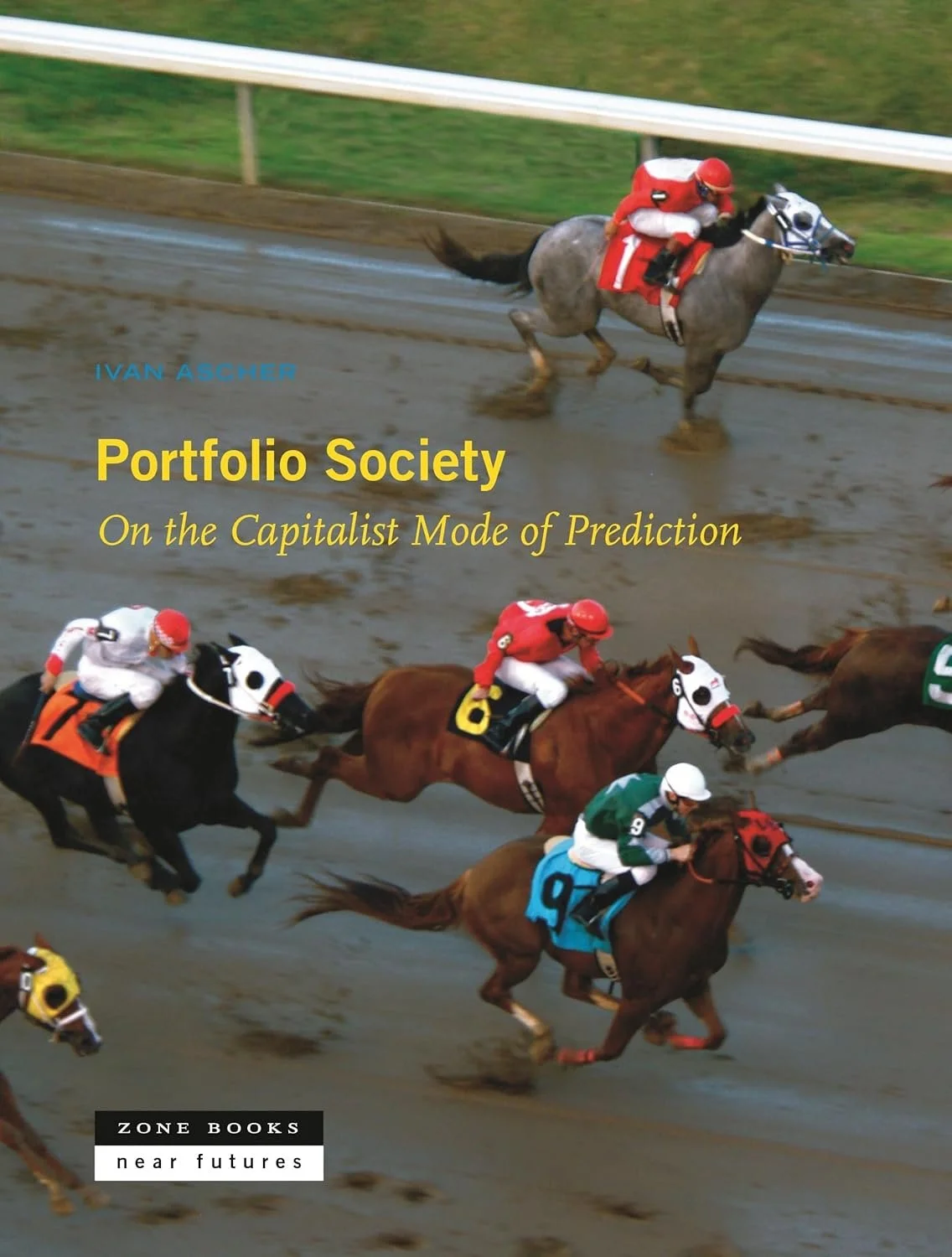
While the economist John Maynard Keynes may have once compared financial capitalism to a casino, with all of the ethical baggage this loaded term constitutes, Ascher suggests that a more apt comparison might be found at the racetrack, where gamblers “are betting on the outcome of a horse race…not merely playing against each other, nor…simply playing against the odds” (121), but also “betting on the outcome of other games being played by other players” (121). This logic emerges from individual derivative contracts priced using the Black–Scholes–Merton model and expands to encompass not only individual investment portfolios using modern portfolio theory, but also society itself through what Ascher, following the business professor Gerald Davis, calls today’s “portfolio society” (10). It explains how contemporary capitalism works for the benefit of the rich—and at the expense of working-class people seeking to buy a home, invest their retirement savings, and engage in other increasingly financialized aspects of daily life.
Portfolio Society: On the Capitalist Mode of Prediction offers an unconventional reading of Capital, but it’s one that sheds new light on both financialization and on Marx’s original critique. Whether readers have more expertise in contemporary economic thought, or in Marxist theory, Ascher’s book-length essay synthesizes the two schools of thought in ways that students from both backgrounds are sure to find illuminating.
-RA