Steven Swarbrick and Jean-Thomas Tremblay— Negative Life: the Cinema of Extinction
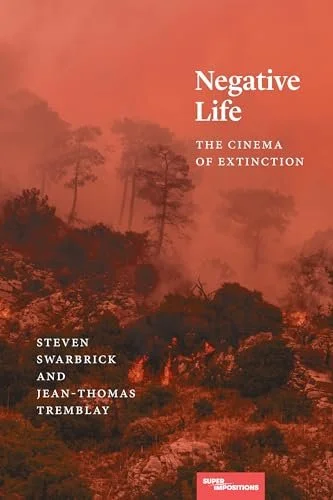
Arguing against the generativity of Donna Haraway, Anna Tsing (less recently) and a wave of fertile-breakdown eco-criticisms, Steven Swarbrick and Jean-Thomas Tremblay begin their book Negative Life (2024) with the following declaration: “life is fractured, lacking, death-driven" (2024, p. vii). The same is true for nature and so, they argue, multispecies collaboration, connectivity and insight will not save us, educate us, uplift us, or soften us through climate catastrophe. “We do not purport to know, and so will not teach, how to die the Anthropocene or the Chtulucene” (p. Xi).
Drawing out Freud's argument of negativity, Swarbrick and Tremblay seek to complicate a popular ecocritical framework, emerging primarily out of Haraway’s multispecies co-presence and kinship, to insist on life’s and so-called nature’s negative value and the structuring antagonism of existence. Negative Life considers a diverse range of films that capture climate apocalypse, what they refer to as “the cinema of extinction”, including those by Kelly Reichardt, Julian Pölsler, Mahesh Mathai, and Paul Schrader and then reads these through a range of cinema studies, philosophies and psychoanalytic, particularly through Frued’s negativity, the antisocial thesis in queer scholarship and Afropessimism. Instead of emancipation or enlightenment, the films they chose orient viewers to “natural” unknowing and non-belonging. These films reveal a failure of recognition in certain ecocriticisms which seek to understand climate change and planetary disaster as an invitation to re-create the world. Instead, these films insist on “an urgent and impossible demand to destroy the world” (p. 15). The natural scenes of these films take the “eco-negative” form of the deflagrated pastoral, terrifying absences, psychic isolation, and inevitable extinction. These representations, say Swarbrick and Tremblay, not only reflect, as Frued would have it, the structural antagonism of existence and an unconscious which forms around incompletion itself, but also the unbearable contradictions, transcendence and trauma of life and subjectivity under climate apocalypse.
This book is a fun foil for environmentalisms which seek to idealize the more-than-human and natural entanglements with some excellent readings of Pölsler’s The Wall (film, 2011), Juzo Itami’s Tampopo (1985), Lee Isaac Chung’s Minari (2020), Valdimar Jóhannsson Lamb (2021), and Paul Schrader’s First Reformed (2017). I particularly enjoyed the chapter on familiar afterlives in Minari and Bhopal Express which explored how toxic exposures, far from necessitating radical, queer and multispecies futurisms, instead necessitated a relapse into the family unit. Babies as vampires etc.
-SM